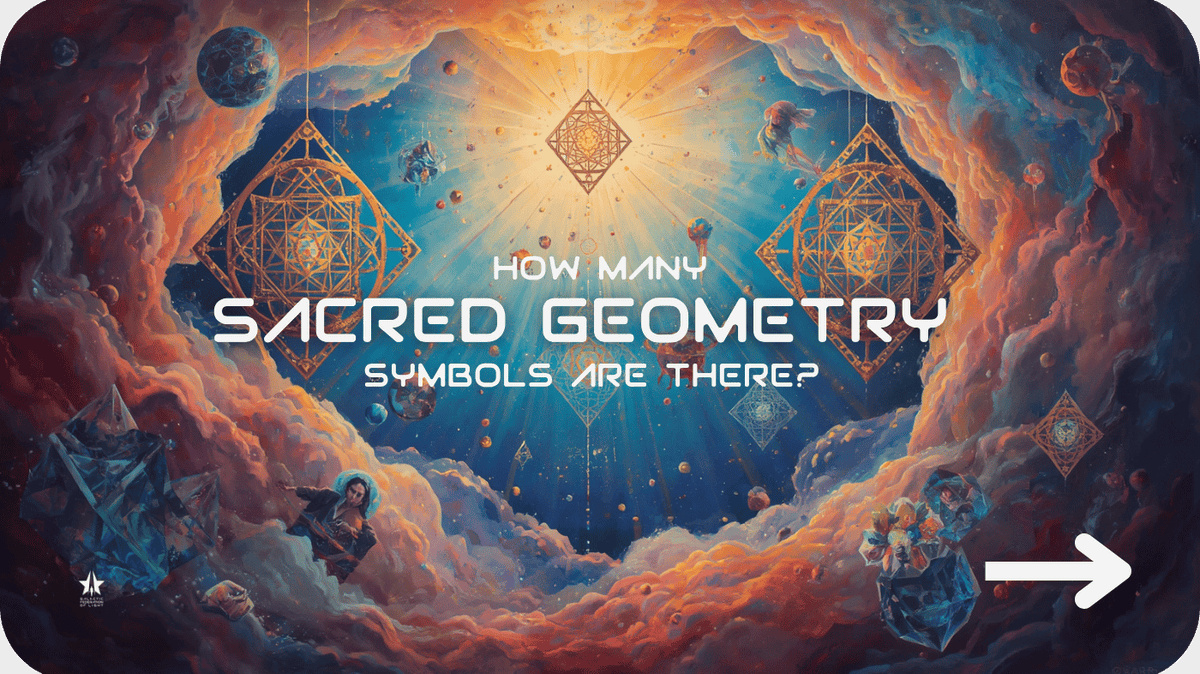
There is no universally accepted number of sacred geometry shapes at present. Lists and total counts often vary across spiritual, mathematical, and artistic traditions because some systems count only fundamental two-dimensional forms, while others include dozens of named composite symbols, energetic mandalas, and repeatable lattice patterns.
Why Sacred Geometry Has No Single Official Count
Sacred geometry has no single official count because it spans mathematics, art, architecture, symbolism, and spiritual practice and is not governed by any single cataloging authority. Depending on the perspective of the teacher or lineage, a list might cover only primitive shapes or expand into a vast and varied collection of complex diagrams.
The Foundational Forms Behind Sacred Geometry
Circles, Squares, Triangles, Stars, and Polygons
Simple geometric forms, including circles, squares, triangles, stars, and multisided polygons, serve as the foundational building blocks for sacred patterns.
In historical traditions such as Islamic geometric design, artisans and scholars organized elaborate patterns using four broad repeat-unit categories: circles, squares, star shapes, and multisided polygons. By applying rotation, overlap, interlacing, repetition, and symmetry, these simple forms multiplied into complex patterns.

The Five Platonic Solids
The five Platonic Solids are the tetrahedron, cube, octahedron, dodecahedron, and icosahedron. They represent a mathematically precise, three-dimensional subset within sacred geometry.
The five Platonic solids are unique because they are the only regular convex polyhedra whose faces are entirely composed of congruent, regular polygons with the same number of faces meeting at each vertex.
Common Sacred Geometry Symbols
The most common sacred geometry symbols include the Vesica Piscis, Seed of Life, Flower of Life, Fruit of Life, Metatron’s Cube, Merkaba, Sri Yantra, and Tree of Life.
- The Vesica Piscis is created by intersecting two identical circles so the center of each rests on the edge of the other. It’s widely associated with creation and dual harmony.
- The Seed of Life is formed by 7 overlapping circles arranged in a symmetrical rosette. It is believed by some to represent the primary blueprint of creation.
- The Flower of Life is a repeating grid of overlapping circles forming a hexagonal floral matrix. It represents universal interconnectedness and cosmic order.
- The Fruit of Life is composed of 13 circles isolated from the wider Flower of Life grid. It can act as a structural framework for mapping out 3D forms.
- Metatron’s Cube is constructed by drawing straight lines between the centers of all 13 circles in the Fruit of Life. Its lines are often illustrated as containing projections of the five Platonic solids.
- The Merkaba or star tetrahedron is formed by 2 interlocking, opposing tetrahedrons that create a 3D star. It’s associated with light-body awareness, balance, and spiritual alignment.
- The Sri Yantra is a sacred diagram made of 9 interlocking triangles radiating outward from a central point, framed by concentric circles and lotus leaves. In some Hindu traditions, it symbolizes the union of divine masculine and feminine principles.
- The Tree of Life is a symbol of ten nodes connected by 22 paths. In Kabbalistic traditions, it symbolizes the divine blueprint connecting cosmic order with physical reality.
How to Understand Different Sacred Geometry Lists
Understanding why sacred geometry lists vary boils down to looking at what each author or tradition chooses to count. You can ask a few questions to help clarify the system being used:
- Is the list counting basic 2D shapes, 3D solids, or composite symbols?
- Are variations or inversions of the same shape listed as separate forms?
- Which cultural or spiritual tradition is providing the definitions?
Shorter lists typically cover foundational forms like the circle, triangle, and square, while a longer list may include secondary derivatives and culture-specific diagrams. Neither approach is wrong; they simply view the subject through different lenses.
Frequently Asked Questions about How Many Sacred Geometry Shapes There Are
-
No, there are not only five sacred geometry shapes. Five refers specifically to the Platonic solids, which are regular three-dimensional polyhedra. Sacred geometry literature commonly encompasses many foundational 2D symbols and composite patterns as well.
-
The five Platonic solids are the tetrahedron, cube, octahedron, dodecahedron, and icosahedron. They are regular convex polyhedra with congruent regular-polygon faces.
-
The Flower of Life is one of the most widely recognized sacred geometry symbols. Built from multiple overlapping circles arranged in a repeating pattern, this ancient design appears in historical temples, art, and spiritual manuscripts across many cultures.
-
Metatron’s Cube is a single two-dimensional composite diagram built from seventy-eight connecting lines and thirteen circles. Because those lines form the outlines of all five Platonic solids simultaneously, it is considered a single composite symbol.
Count the Forms, Then Look for the Connections
Ultimately, there is no universally accepted total number of sacred geometry shapes, but grouping the best-known forms makes the subject easier to explore. For further reading, check out our complete guide to Sacred Geometry Symbols and Meanings and discover our Sacred Geometry Collection to wear your intentions in your day-to-day reality.
Related Topics
Published
Updated